Dr. Delminquoe L Cunningham
Project Outcomes at a Glance
Identified Key Drivers
Analysis of ESS data proved that psychographics (Political Interest, Media Trust) were stronger behavior predictors than simple demographics.
Defined "The Engaged Critic"
Identified a prime 15-20% market segment: a high-interest, low-trust user frustrated with existing media and willing to pay for quality.
Actionable Prototype Plan
Delivered a focused qualitative plan to test the prototype with 20-28 high-value users, saving time and R&D budget.
Project Details
My Roles
- Market Researcher
- Data Strategist
- UX Researcher
Project Type
- Phase 1: Research & Strategy
Tools & Methods
- European Social Survey (ESS)
- K-Means Clustering
- Regression Analysis
- Persona Development
- Qualitative Interview Planning
Project Details
The Challenge
The client had a product concept for a news site but an undefined audience. They believed demographic and socioeconomic factors were the key to understanding media usage. Without a clear target, the project risked significant R&D waste by building a product for “everyone” and appealing to no one, failing to stand out in a saturated market.
My Approach: A Mixed-Method Strategy
My goal was to provide a data-driven definition of the *most viable* target audience. The strategy involved two phases:
1. Quantitative Analysis: Use European Social Survey (ESS) data to discover *what* segments exist.
2. Qualitative Planning: Design a plan to interview those segments to understand *why* they behave as they do, directly informing the prototype.
From Insight to Action
To find the opportunity, I first analyzed the ESS data to identify key variables. This confirmed that media habits (`netuse`, `tvtot`) were less correlated with simple demographics and more strongly linked to psychographics.
- I proposed a **K-Means clustering model** based on the two most powerful variables: `polintr` (Political Interest) and `trstplt` (Trust in Politicians/Media).
- This model revealed four distinct personas, which we visualized on a 2×2 matrix to make the market map clear to the stakeholders.
Market Segmentation by Country Map
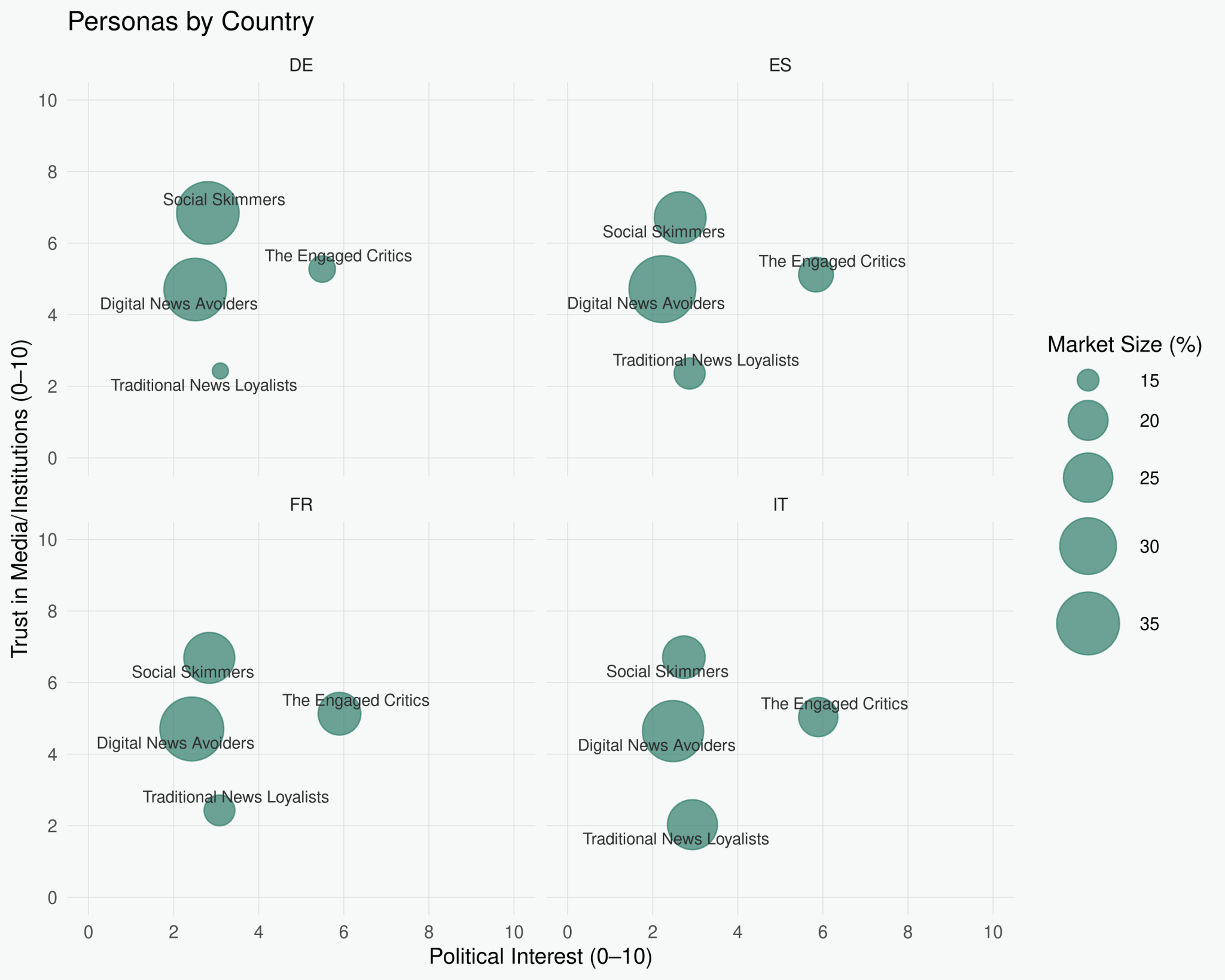
- The analysis proved the primary target was not defined by age or income, but by a mindset. We named this segment **”The Engaged Critics.”**
- This segment (est. 15-20% of the market) is actively interested in news but deeply distrusts existing sources, making them hungry for a transparent, in-depth alternative.
Strategic Impact
The research fundamentally shifted the client’s product strategy and provided a clear, actionable path forward, de-risking the project.
- The client’s value proposition was redefined: from “a new news site” to “**the first news source for engaged, skeptical readers**.”
- This clarity allowed the product team to prioritize features that build trust (e.g., data transparency, source-linking) over commodity features (e.g., breaking news alerts).
- I delivered a focused qualitative plan to validate the prototype with **20-28 recruits** (5-7 per country) who fit “The Engaged Critic” profile, ensuring the next phase of R&D was aimed at the right target.
Key Takeaways
This project was a powerful reminder that “who” a customer is (demographics) is far less important than “how” they think (psychographics). The client’s initial assumption—that age or income would be the key—would have led them to build a generic product for a disengaged audience.
Dr. Delminquoe L Cunningham is proudly powered by WordPress