
Category: UX Research

This is the deep dive into “Interrogating the User.” This category highlights specific methodologies like usability testing, interviews, field studies, and contextual inquiry. I showcase how I translate observed user pain points, motivations, and mental models into clear, prioritized recommendations for design and strategy.

  • From Chaos to Clarity: Building a ResOps Engine

    From Chaos to Clarity: Building a ResOps Engine

    Project Outcomes at a Glance

    66% Faster

    Reduced Time-to-Insight from 6 weeks to 10 days, enabling weekly iteration cycles.

    $150k Saved

    Prevented engineering rework by identifying payment flow flaws pre-code.

     
    200% Capacity

    Automated recruitment allowed us to run 6 concurrent studies per month.

    15% Retention

    Data-driven onboarding redesign directly lifted Day-7 user retention.

    Project Details
    My Role
    • Senior UX Researcher
    • UX Architect
    • Ops Lead
    • Service Designer
    Timeline
    • Seven Months (2022)

    Tools & Methods
    • Qualtrics
    • EnjoyHQ
    • Calendly
    • Jira
    The Challenge: A Mountain of Ambition, No Map

    First Command Bank’s traditional product lifecycle was too slow for the modern market. Critical insights were lost in siloed drives, and every research effort was a fire drill that wasted weeks on manual logistics. Without a fundamental change, the high-stakes ‘Digital First’ MVP was at risk of budget overruns and market failure.

    My Role: Systems Architect

    As the Senior Researcher and UX Architect, I didn’t just execute studies; I designed the system for how we learn. My goal was to build a scalable “ResOps Engine” that integrated participant management, data governance, and insight repository tools into a seamless internal workflow. I secured the $50k budget, selected the vendors, and drove adoption across Engineering and Product leadership.

    Building the Engine: 4 Pillars Strategy

    Building the Engine: The 4 Pillars

    From Ad-Hoc Chaos to Automated Precision

    Standardize the Intake

    No clear goals

    Created a Standardized Research Plan Template as the single source of truth, forcing teams to define hypotheses upfront.

    Result Defined Hypotheses

    Scale Participants

    Spreadsheet Chaos

    Automated the pipeline using Qualtrics for screening and Calendly for scheduling to remove bottlenecks.

    Recruitment Time 2 Weeks ➔ 48 Hours

    Single Source of Truth

    Insights lost in inbox

    Implemented EnjoyHQ as a central repository with a global taxonomy and a “48-hour rule” for logging data.

    Adoption 70% PRD Citations

    Hybrid Insight Model

    Admin overload

    Trained assistants to leverage AI-powered analysis for initial tagging, freeing seniors for strategy.

    Admin Load Reduced by 50%

    The Result: A Culture of Evidence

    The ResOps engine didn’t just save time; it changed how the bank built products. By providing a reliable, on-demand pipeline of insights, we enabled product pods to run weekly test-and-iterate cycles.

    • De-Risked Investment: Early feedback identified a critical flaw in the MVP’s payment flow. We pivoted before writing code, saving an estimated $150,000.
    • Strategic Partnership: Research shifted from a reactive service to a proactive partner. Within six months, Marketing and Data Science teams adopted our repository, creating a shared, cross-functional understanding of our users.

    Key Takeaways

    This initiative proved that in a high-velocity environment, the biggest barrier to user-centricity isn’t a lack of empathy, but a lack of efficiency. By treating Research Operations as a product itself, we removed the friction that made research feel “expensive” and slow.

    “We didn’t just build a process; we built a path of least resistance. Once it became easier for the team to get insights than to guess, the culture shifted from opinion-based to evidence-based almost overnight.”

  • News Platform Expansion: European News Site Market Segmentation

    News Platform Expansion: European News Site Market Segmentation

    Project Outcomes at a Glance

    Identified Key Drivers

    Analysis of ESS data proved that psychographics (Political Interest, Media Trust) were stronger behavior predictors than simple demographics.

    Defined “The Engaged Critic”

    Identified a prime 15-20% market segment: a high-interest, low-trust user frustrated with existing media and willing to pay for quality.

    Actionable Prototype Plan

    Delivered a focused qualitative plan to test the prototype with 20-28 high-value users, saving time and R&D budget.

    Project Details
    My Roles
    • Market Researcher
    • Data Strategist
    • UX Researcher 
    Project Type
    • Phase 1: Research & Strategy
    Tools & Methods
    • European Social Survey (ESS)
    • K-Means Clustering
    • Regression Analysis
    • Persona Development
    • Qualitative Interview Planning
    Project Details

    The Challenge

    The client had a product concept for a news site but an undefined audience. They believed demographic and socioeconomic factors were the key to understanding media usage. Without a clear target, the project risked significant R&D waste by building a product for “everyone” and appealing to no one, failing to stand out in a saturated market.

    My Approach: A Mixed-Method Strategy

    My goal was to provide a data-driven definition of the *most viable* target audience. The strategy involved two phases:

    1. Quantitative Analysis: Use European Social Survey (ESS) data to discover *what* segments exist.
    2. Qualitative Planning: Design a plan to interview those segments to understand *why* they behave as they do, directly informing the prototype.

    From Insight to Action

    To find the opportunity, I first analyzed the ESS data to identify key variables. This confirmed that media habits (`netuse`, `tvtot`) were less correlated with simple demographics and more strongly linked to psychographics.

    • I proposed a **K-Means clustering model** based on the two most powerful variables: `polintr` (Political Interest) and `trstplt` (Trust in Politicians/Media).
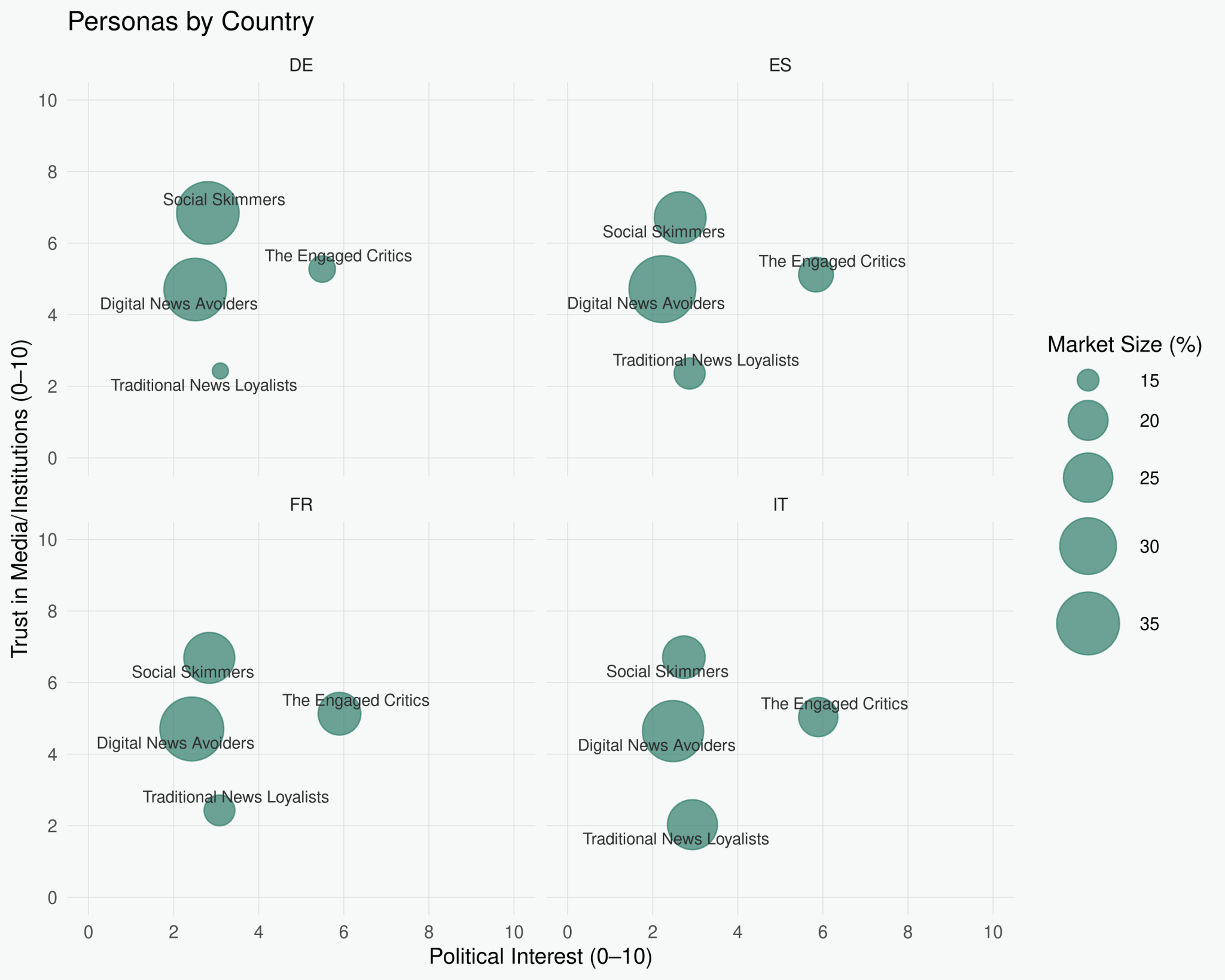
    • This model revealed four distinct personas, which we visualized on a 2×2 matrix to make the market map clear to the stakeholders.
    Market Segmentation by Country Map
    The visualization immediately showed the client where the opportunity was: not in the crowded “Traditional” or “Avoider” spaces, but in a niche of frustrated, engaged users.
    • The analysis proved the primary target was not defined by age or income, but by a mindset. We named this segment **”The Engaged Critics.”**
    • This segment (est. 15-20% of the market) is actively interested in news but deeply distrusts existing sources, making them hungry for a transparent, in-depth alternative.

    Strategic Impact

    The research fundamentally shifted the client’s product strategy and provided a clear, actionable path forward, de-risking the project.

    • The client’s value proposition was redefined: from “a new news site” to “**the first news source for engaged, skeptical readers**.”
    • This clarity allowed the product team to prioritize features that build trust (e.g., data transparency, source-linking) over commodity features (e.g., breaking news alerts).
    • I delivered a focused qualitative plan to validate the prototype with **20-28 recruits** (5-7 per country) who fit “The Engaged Critic” profile, ensuring the next phase of R&D was aimed at the right target.

    Key Takeaways

    This project was a powerful reminder that “who” a customer is (demographics) is far less important than “how” they think (psychographics). The client’s initial assumption—that age or income would be the key—would have led them to build a generic product for a disengaged audience.